 Image 1 of 1
A student communicates, and half the room misses it.
This tool helps teams recognize and understand early, pre-symbolic communication so it can be supported consistently across people and settings.
What this is:
A structured assessment and observation tool focused on symbolic communication, bridging pre-symbolic behavior to concrete, abstract, and combined symbol use.
Who this is for:
Speech-language pathologists
Special educators
Teams supporting individuals with complex communication needs
Anyone working with early or symbolic communicators
What's included:
Overview of symbolic communication and Rowland's three levels
Observation and elicitation guidance
Flowchart for determining level
Skill checklist and partner facilitation hierarchy
Data collection tools
Team-friendly summary pages
Looking for more detail?
Here's a deeper look at how this tool works:
Is this person using symbols to communicate, and does your team know this is a bridge to AAC, not a gate in front of it?
Symbolic Communication is the sixth booklet in The Shared Map, a modular clinical mini-booklet series for assessing communication in individuals with complex communication needs.
Grounded in Rowland's three symbolic levels, this booklet distinguishes concrete symbols, abstract symbols, and language, and treats symbolic use as a bridge toward AAC rather than a prerequisite that gates access to it.
This booklet also accounts for key distinctions that change what you teach next: concrete versus abstract symbol use, the fact that any modality counts, and the difference between single and combined symbol use, including aided language modeling in the facilitation hierarchy.
What is inside:
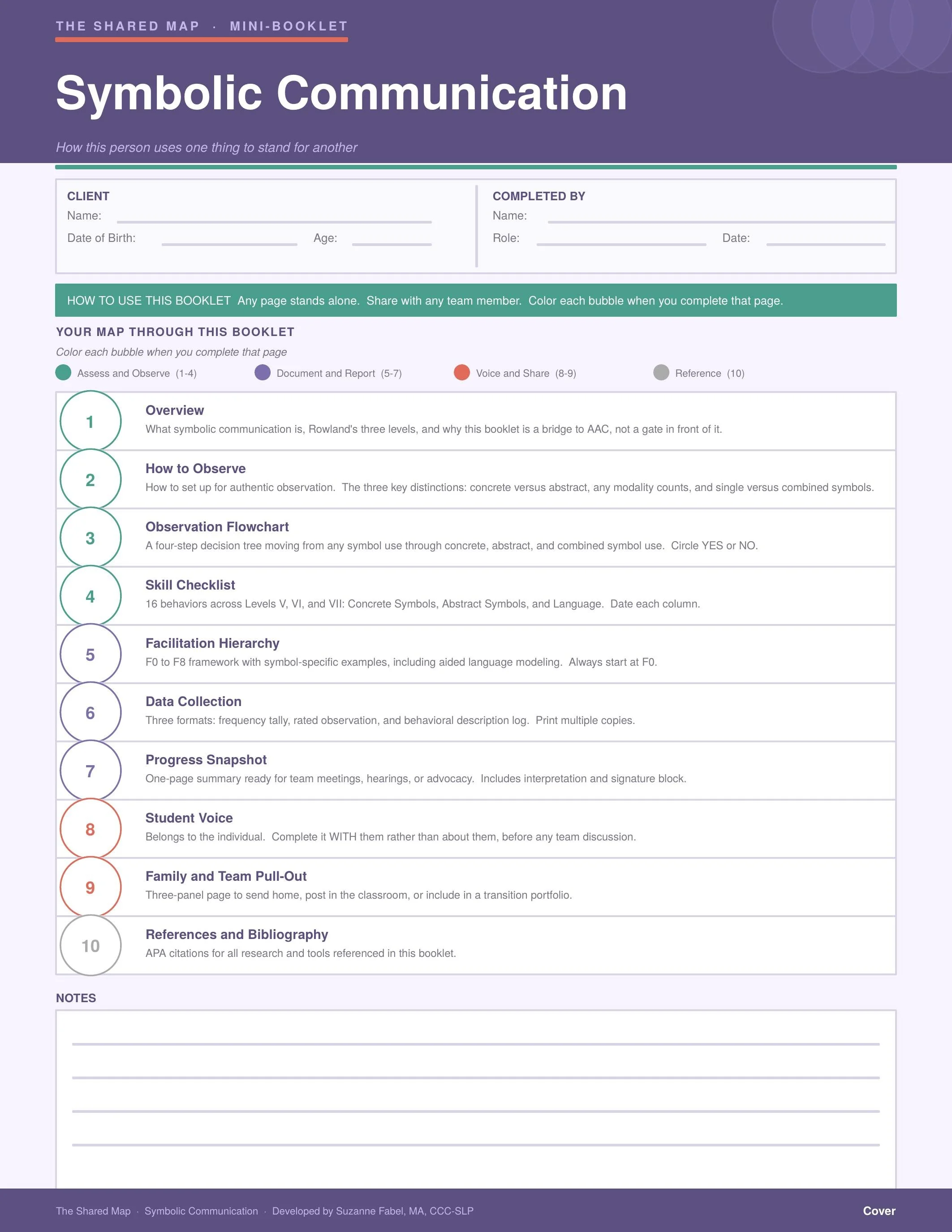
Cover with client info, path map tracker, and notes space
Overview: what symbolic communication is, Rowland's three levels, and why this booklet is a bridge to AAC, not a gate in front of it
How to Observe: the three key distinctions (concrete versus abstract, any modality counts, single versus combined symbols)
Observation Flowchart: four-step decision tree moving from any symbol use through concrete, abstract, and combined symbol use
Skill Checklist: 16 behaviors across Levels V, VI, and VII: Concrete Symbols, Abstract Symbols, and Language
Partner Facilitation Hierarchy (F0-F8): symbol-specific examples, including aided language modeling
Data Collection Sheet: tally, rating grid, and behavioral description formats
Progress Snapshot: team meeting- and hearing-ready with interpretation and signature block
Student Voice page
Family and Team Pull-Out: three panels for home, classroom, and team use
References and Bibliography: APA format
Print single-sided or double-sided.
Includes color and black-and-white versions.
Age range: all ages.
A student communicates, and half the room misses it.
This tool helps teams recognize and understand early, pre-symbolic communication so it can be supported consistently across people and settings.
What this is:
A structured assessment and observation tool focused on symbolic communication, bridging pre-symbolic behavior to concrete, abstract, and combined symbol use.
Who this is for:
Speech-language pathologists
Special educators
Teams supporting individuals with complex communication needs
Anyone working with early or symbolic communicators
What's included:
Overview of symbolic communication and Rowland's three levels
Observation and elicitation guidance
Flowchart for determining level
Skill checklist and partner facilitation hierarchy
Data collection tools
Team-friendly summary pages
Looking for more detail?
Here's a deeper look at how this tool works:
Is this person using symbols to communicate, and does your team know this is a bridge to AAC, not a gate in front of it?
Symbolic Communication is the sixth booklet in The Shared Map, a modular clinical mini-booklet series for assessing communication in individuals with complex communication needs.
Grounded in Rowland's three symbolic levels, this booklet distinguishes concrete symbols, abstract symbols, and language, and treats symbolic use as a bridge toward AAC rather than a prerequisite that gates access to it.
This booklet also accounts for key distinctions that change what you teach next: concrete versus abstract symbol use, the fact that any modality counts, and the difference between single and combined symbol use, including aided language modeling in the facilitation hierarchy.
What is inside:
Cover with client info, path map tracker, and notes space
Overview: what symbolic communication is, Rowland's three levels, and why this booklet is a bridge to AAC, not a gate in front of it
How to Observe: the three key distinctions (concrete versus abstract, any modality counts, single versus combined symbols)
Observation Flowchart: four-step decision tree moving from any symbol use through concrete, abstract, and combined symbol use
Skill Checklist: 16 behaviors across Levels V, VI, and VII: Concrete Symbols, Abstract Symbols, and Language
Partner Facilitation Hierarchy (F0-F8): symbol-specific examples, including aided language modeling
Data Collection Sheet: tally, rating grid, and behavioral description formats
Progress Snapshot: team meeting- and hearing-ready with interpretation and signature block
Student Voice page
Family and Team Pull-Out: three panels for home, classroom, and team use
References and Bibliography: APA format
Print single-sided or double-sided.
Includes color and black-and-white versions.
Age range: all ages.