 Image 1 of 1
A student communicates, and half the room misses it.
This tool helps teams recognize and understand early, pre-symbolic communication so it can be supported consistently across people and settings.
What this is:
A structured assessment and observation tool focused on actions on objects within the pre-symbolic stage of communication and cognitive development.
Who this is for:
Speech-language pathologists
Special educators
Teams supporting individuals with complex communication needs
Anyone working with early or pre-symbolic communicators
What's included:
Overview of actions on objects and their role in early development
Observation and elicitation guidance
Structured tools for identifying and describing object interaction patterns
Data collection options for tracking progress
Team-friendly pages for sharing information across settings
Looking for more detail?
Here's a deeper look at how this tool works:
What does this person do with the world around them?
And what does it tell us about where they are as a communicator?
Actions on Objects is the second booklet in The Shared Map, a modular clinical mini-booklet series for assessing communication in individuals with complex communication needs.
This booklet maps the cognitive foundation of communication: how a person explores, uses, and solves problems with objects. Before a person uses words, pictures, or symbols, they use the physical world to learn that actions have effects, that objects have distinct properties, and that one thing can stand for another. This sensorimotor learning is not a prerequisite for communication, rather IT IS communication.
This booklet uses the Uzgiris-Hunt developmental sequence, validated for use with individuals of all ages, to assess six levels of object exploration from basic attending through complex means-end problem solving.
What is inside:
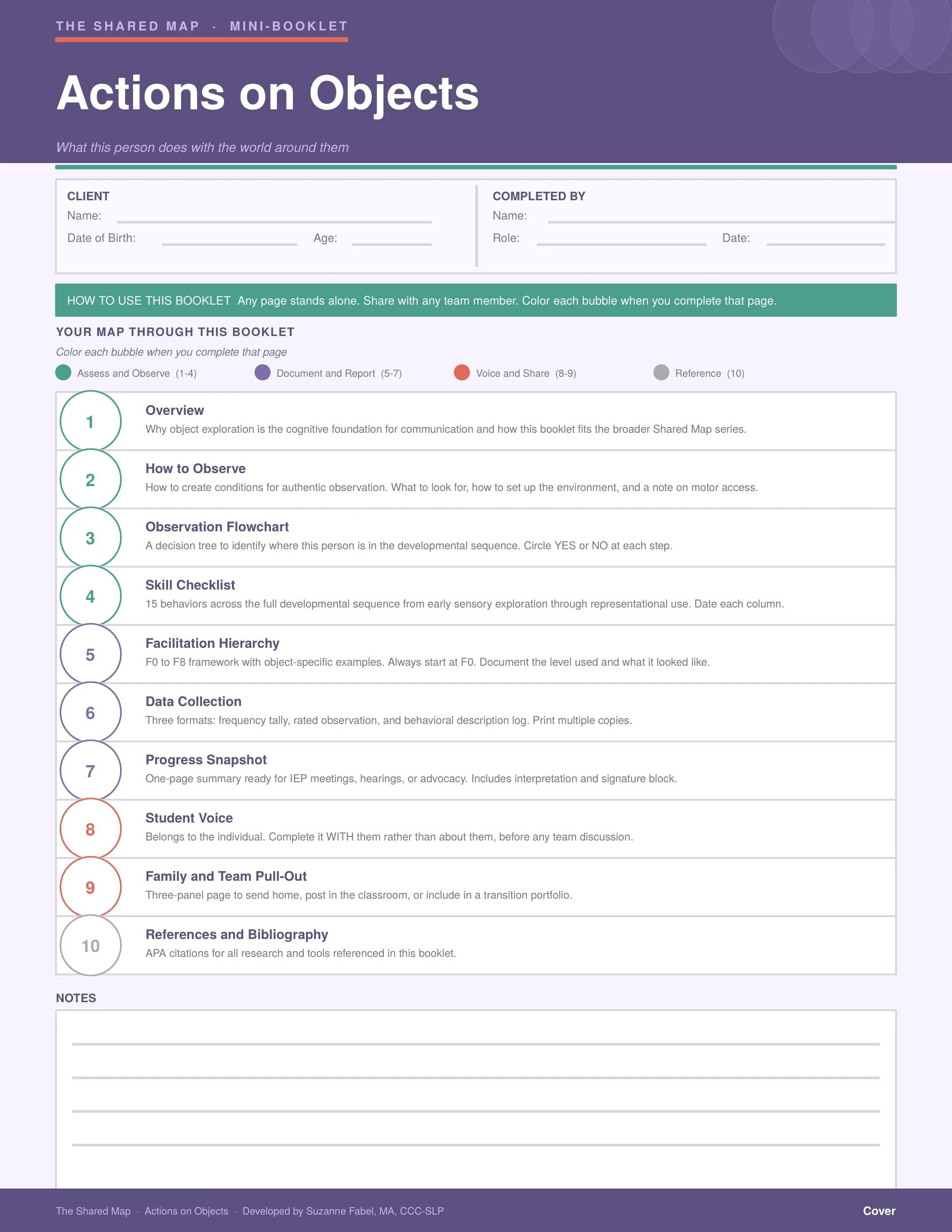
Cover with client info, path map tracker, and notes space
Overview: cognitive foundation of object exploration, AAC implications, connection to play development
How to Observe: probe independence first, motor access considerations, what to set up
Observation Flowchart: six-level decision tree from attending to indirect means-end
Skill Checklist: six developmental levels with specific observable behaviors
Partner Facilitation Hierarchy (F0-F8): consistent across the series
Data Collection Sheet: tally, rating grid, and behavioral description formats
Progress Snapshot: IEP- and hearing-ready with signature block
Student Voice page
Family and Team Pull-Out: three panels for home, classroom, and team use
References and Bibliography: APA format
Print single-sided or double-sided.
Includes color and black-and-white versions.
Age range: all ages.
A student communicates, and half the room misses it.
This tool helps teams recognize and understand early, pre-symbolic communication so it can be supported consistently across people and settings.
What this is:
A structured assessment and observation tool focused on actions on objects within the pre-symbolic stage of communication and cognitive development.
Who this is for:
Speech-language pathologists
Special educators
Teams supporting individuals with complex communication needs
Anyone working with early or pre-symbolic communicators
What's included:
Overview of actions on objects and their role in early development
Observation and elicitation guidance
Structured tools for identifying and describing object interaction patterns
Data collection options for tracking progress
Team-friendly pages for sharing information across settings
Looking for more detail?
Here's a deeper look at how this tool works:
What does this person do with the world around them?
And what does it tell us about where they are as a communicator?
Actions on Objects is the second booklet in The Shared Map, a modular clinical mini-booklet series for assessing communication in individuals with complex communication needs.
This booklet maps the cognitive foundation of communication: how a person explores, uses, and solves problems with objects. Before a person uses words, pictures, or symbols, they use the physical world to learn that actions have effects, that objects have distinct properties, and that one thing can stand for another. This sensorimotor learning is not a prerequisite for communication, rather IT IS communication.
This booklet uses the Uzgiris-Hunt developmental sequence, validated for use with individuals of all ages, to assess six levels of object exploration from basic attending through complex means-end problem solving.
What is inside:
Cover with client info, path map tracker, and notes space
Overview: cognitive foundation of object exploration, AAC implications, connection to play development
How to Observe: probe independence first, motor access considerations, what to set up
Observation Flowchart: six-level decision tree from attending to indirect means-end
Skill Checklist: six developmental levels with specific observable behaviors
Partner Facilitation Hierarchy (F0-F8): consistent across the series
Data Collection Sheet: tally, rating grid, and behavioral description formats
Progress Snapshot: IEP- and hearing-ready with signature block
Student Voice page
Family and Team Pull-Out: three panels for home, classroom, and team use
References and Bibliography: APA format
Print single-sided or double-sided.
Includes color and black-and-white versions.
Age range: all ages.