 Image 1 of 1
A free, research-based reference card for anyone supporting individuals with complex communication needs. (This is a sample from The Shared Map™ framework, a system designed to help teams see and support communication consistently.)
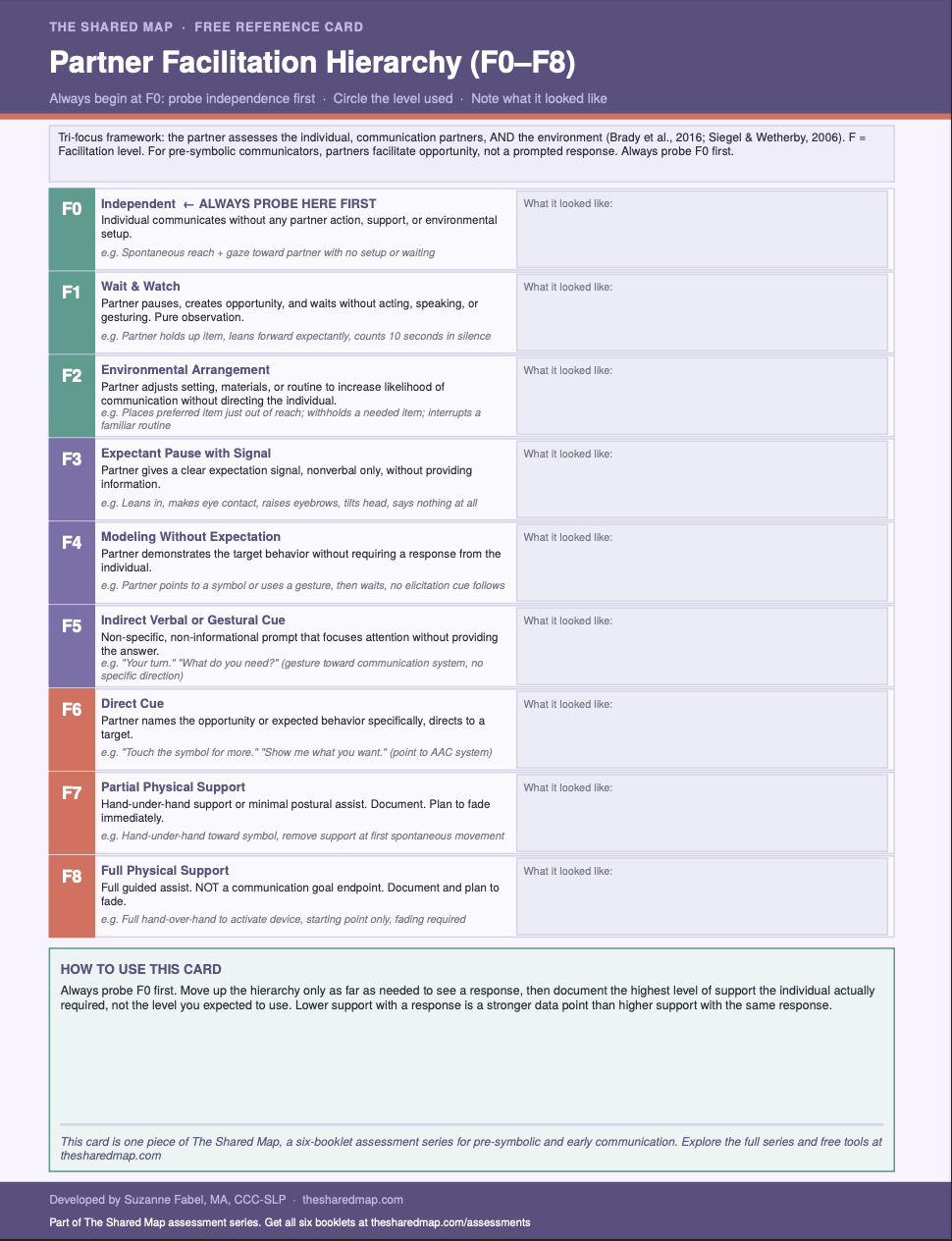
The Partner Facilitation Hierarchy (F0-F8) is a partner support continuum, not a prompt hierarchy, that keeps every interaction focused on independence rather than compliance. This two-sided reference card presents the complete F0-F8 framework with descriptions, the tri-focus model (individual, partners, environments), and a notes side for use in the room.
What is inside:
Front: F0-F8 table with descriptions, ALWAYS START HERE callout on F0, tri-focus framework note, and research base
Back: client info strip and full ruled notes page for in-the-room use
Color and black-and-white versions included
Part of The Shared Map mini-booklet series and carried consistently across every booklet in the series
Research base: Brady et al. (2016); Rowland (2011); Wetherby & Prizant (1989); Siegel & Wetherby (2006).
A free, research-based reference card for anyone supporting individuals with complex communication needs. (This is a sample from The Shared Map™ framework, a system designed to help teams see and support communication consistently.)
The Partner Facilitation Hierarchy (F0-F8) is a partner support continuum, not a prompt hierarchy, that keeps every interaction focused on independence rather than compliance. This two-sided reference card presents the complete F0-F8 framework with descriptions, the tri-focus model (individual, partners, environments), and a notes side for use in the room.
What is inside:
Front: F0-F8 table with descriptions, ALWAYS START HERE callout on F0, tri-focus framework note, and research base
Back: client info strip and full ruled notes page for in-the-room use
Color and black-and-white versions included
Part of The Shared Map mini-booklet series and carried consistently across every booklet in the series
Research base: Brady et al. (2016); Rowland (2011); Wetherby & Prizant (1989); Siegel & Wetherby (2006).