 Image 1 of 1
A student communicates, and half the room misses it.
This tool helps teams recognize and understand early, pre-symbolic communication so it can be supported consistently across people and settings.
What this is:
A structured assessment and observation tool focused on comprehension and receptive language, revealing what expressive language alone cannot show.
Who this is for:
Speech-language pathologists
Special educators
Teams supporting individuals with complex communication needs
Anyone working with early or pre-symbolic communicators
What's included:
Overview of comprehension and why standard tests often underestimate it
Observation and elicitation guidance
Flowchart for determining level
Skill checklist and partner facilitation hierarchy
Data collection tools
Team-friendly summary pages
Looking for more detail?
Here's a deeper look at how this tool works:
Does this person understand more than they can show you, and is your team measuring comprehension in a way that accounts for that?
Comprehension is the fifth booklet in The Shared Map, a modular clinical mini-booklet series for assessing communication in individuals with complex communication needs.
Expressive language alone cannot tell you what a person understands, and standard receptive language tests often underestimate comprehension in individuals with motor, speech, or attention differences.
This booklet tests comprehension using more than one response option, so a motor or speech barrier is never mistaken for a comprehension gap.
It includes a dedicated receptive-expressive gap field on the Progress Snapshot, since roughly one quarter of minimally verbal individuals show receptive skills clearly ahead of their expressive level.
What is inside:
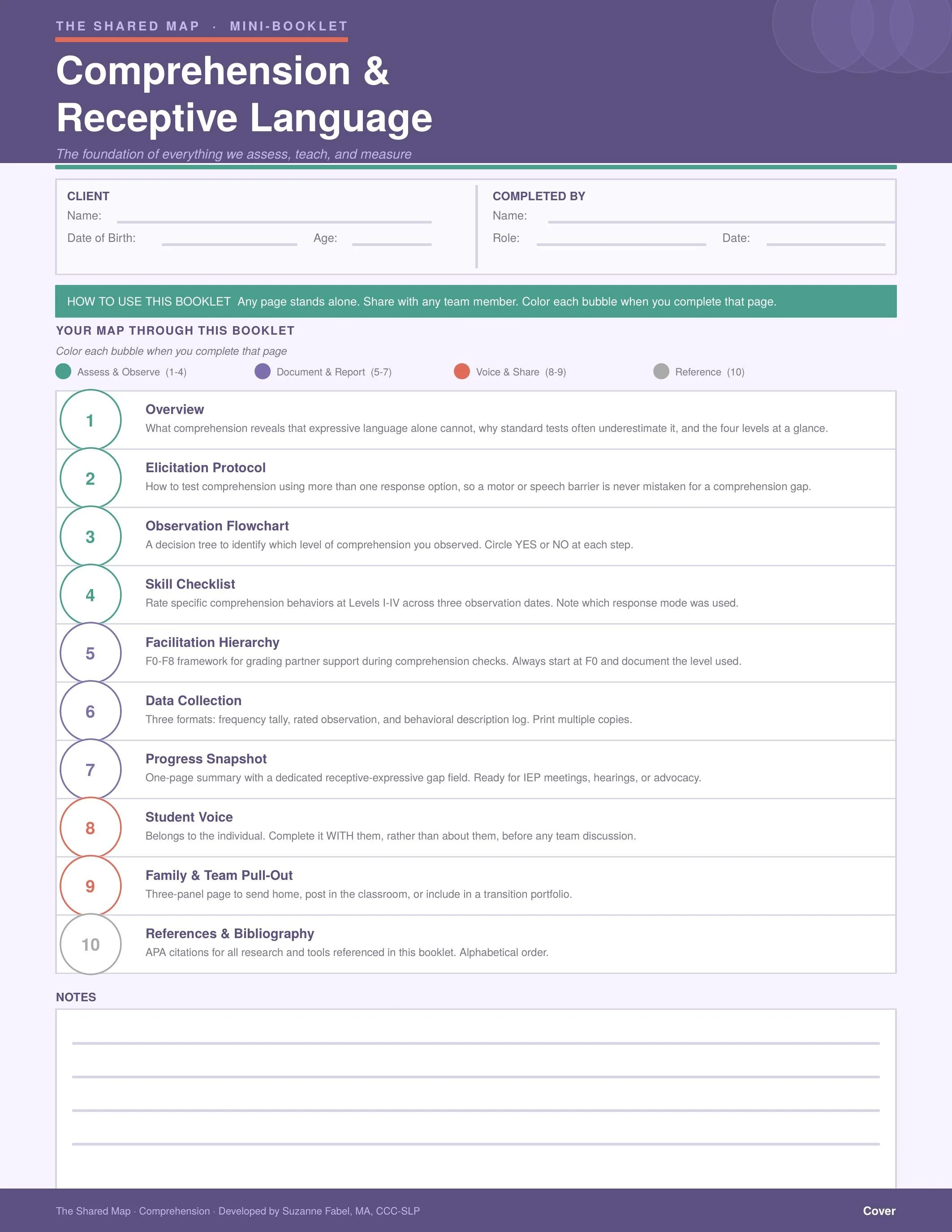
Cover with client info, path map tracker, and notes space
Overview: what comprehension reveals that expressive language alone cannot, and why standard tests often underestimate it
Elicitation Protocol: how to test comprehension using more than one response option
Observation Flowchart: decision tree identifying which level of comprehension you observed
Skill Checklist: comprehension behaviors at Levels I-IV across three observation dates, noting response mode used
Partner Facilitation Hierarchy (F0-F8): comprehension-specific examples
Data Collection Sheet: tally, rating grid, and behavioral description formats
Progress Snapshot: dedicated receptive-expressive gap field, ready for IEP meetings, hearings, or advocacy
Student Voice page
Family and Team Pull-Out: three panels for home, classroom, and team use
References and Bibliography: APA format
Print single-sided or double-sided.
Includes color and black-and-white versions.
Age range: all ages.
A student communicates, and half the room misses it.
This tool helps teams recognize and understand early, pre-symbolic communication so it can be supported consistently across people and settings.
What this is:
A structured assessment and observation tool focused on comprehension and receptive language, revealing what expressive language alone cannot show.
Who this is for:
Speech-language pathologists
Special educators
Teams supporting individuals with complex communication needs
Anyone working with early or pre-symbolic communicators
What's included:
Overview of comprehension and why standard tests often underestimate it
Observation and elicitation guidance
Flowchart for determining level
Skill checklist and partner facilitation hierarchy
Data collection tools
Team-friendly summary pages
Looking for more detail?
Here's a deeper look at how this tool works:
Does this person understand more than they can show you, and is your team measuring comprehension in a way that accounts for that?
Comprehension is the fifth booklet in The Shared Map, a modular clinical mini-booklet series for assessing communication in individuals with complex communication needs.
Expressive language alone cannot tell you what a person understands, and standard receptive language tests often underestimate comprehension in individuals with motor, speech, or attention differences.
This booklet tests comprehension using more than one response option, so a motor or speech barrier is never mistaken for a comprehension gap.
It includes a dedicated receptive-expressive gap field on the Progress Snapshot, since roughly one quarter of minimally verbal individuals show receptive skills clearly ahead of their expressive level.
What is inside:
Cover with client info, path map tracker, and notes space
Overview: what comprehension reveals that expressive language alone cannot, and why standard tests often underestimate it
Elicitation Protocol: how to test comprehension using more than one response option
Observation Flowchart: decision tree identifying which level of comprehension you observed
Skill Checklist: comprehension behaviors at Levels I-IV across three observation dates, noting response mode used
Partner Facilitation Hierarchy (F0-F8): comprehension-specific examples
Data Collection Sheet: tally, rating grid, and behavioral description formats
Progress Snapshot: dedicated receptive-expressive gap field, ready for IEP meetings, hearings, or advocacy
Student Voice page
Family and Team Pull-Out: three panels for home, classroom, and team use
References and Bibliography: APA format
Print single-sided or double-sided.
Includes color and black-and-white versions.
Age range: all ages.