 Image 1 of 1
A student communicates, and half the room misses it. This tool helps teams recognize and understand early, pre-symbolic communication so it can be supported consistently across people and settings.
What this is:
A structured assessment and observation tool focused on communication intentionality within the pre-symbolic stage of communication development.
Who this is for:
Speech-language pathologists
Special educators
Teams supporting individuals with complex communication needs
Anyone working with early or pre-symbolic communicators
What's included:
Overview of communication intentionality and why it matters
Observation and elicitation guidance
Flowchart for determining level (I-IV)
Skill checklist and partner facilitation hierarchy
Data collection tools
Team-friendly summary pages
Looking for more detail?
Here's a deeper look at how this tool works.
Is this person communicating intentionally? And does your whole team agree on what that means?
Communication Intentionality is the first booklet in The Shared Map, a modular clinical mini-booklet series for assessing communication in individuals with complex communication needs (CCN).
Whether you work in a school, clinic, or home setting, this tool gives every person on the team (the SLP, the teacher, the para, the family) the same clear picture of what communication looks like for this individual, right now. Grounded in the Rowland Communication Matrix (Levels I-IV), the CSBS-DP (Wetherby & Prizant), and NJC guidance, this 11-page booklet walks you through the full pre-symbolic intentionality profile, from pre-intentional behavior through conventional communication. Every page stands alone and can be shared with any team member.
What is inside:
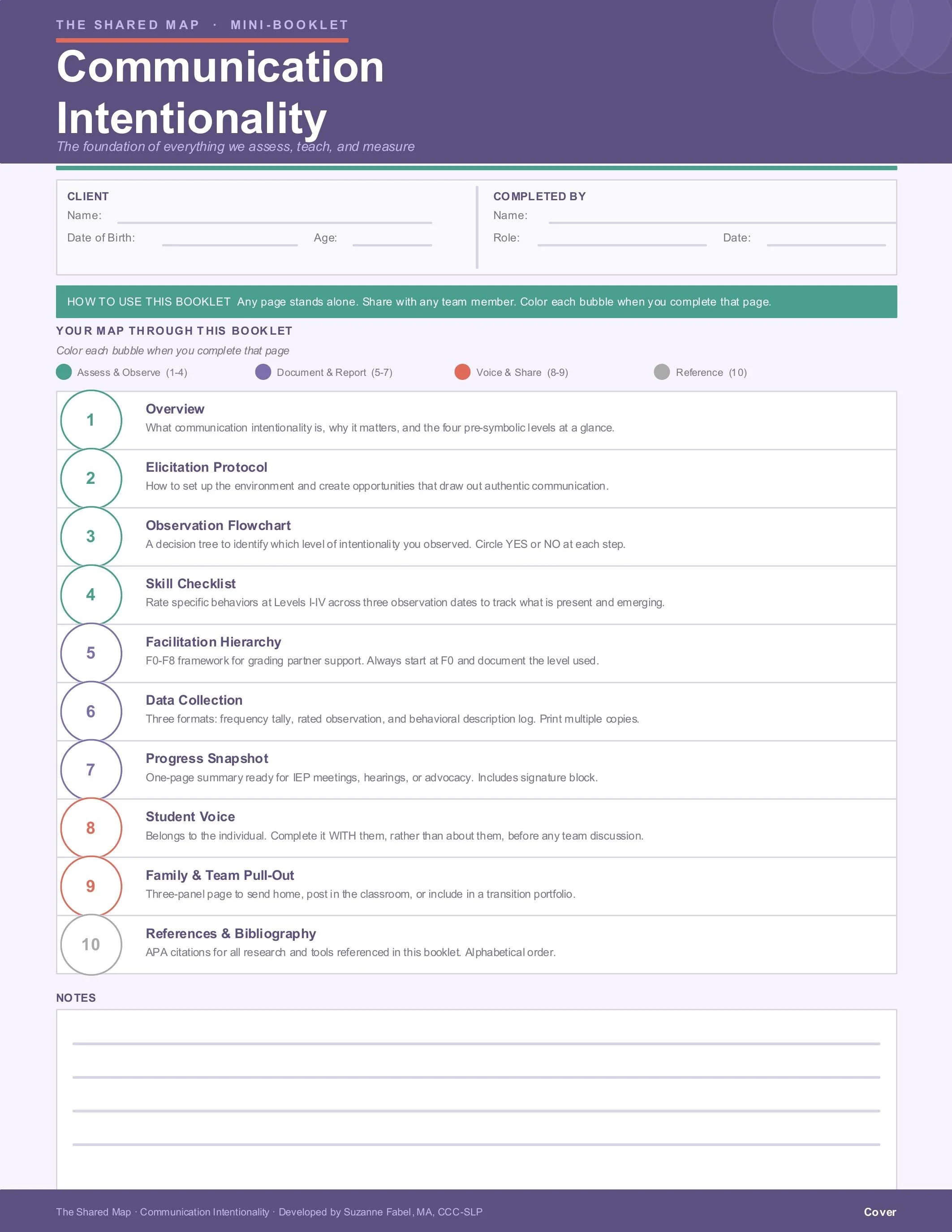
Cover with client info, a color-in page tracker, and notes space
Overview: NJC Communication Bill of Rights, plus clinical and plain-language explanations of intentionality
Elicitation Protocol: the 7 CSBS-DP early communication areas, communicative temptation, and a 5-step observation protocol
Observation Flowchart: a decision tree routing to Levels I-IV; circle YES or NO at each step
Skill Checklist: Rowland Levels I-IV, rated across three observation dates
Partner Facilitation Hierarchy (F0-F8): an original framework built on the tri-focus model (Brady et al., 2016)
Data Collection Sheet: frequency tally, rated observation, and behavioral description log
Progress Snapshot: IEP- and hearing-ready, with a signature block
Student Voice: the individual's own page, completed before team and family pages
Family and Team Pull-Out: three panels for home, classroom, and team use
References and Bibliography: APA format, alphabetical
Print single-sided or double-sided.
Includes color and black-and-white versions in one PDF.
Age range: all ages.
Last updated: September 2026.
A student communicates, and half the room misses it. This tool helps teams recognize and understand early, pre-symbolic communication so it can be supported consistently across people and settings.
What this is:
A structured assessment and observation tool focused on communication intentionality within the pre-symbolic stage of communication development.
Who this is for:
Speech-language pathologists
Special educators
Teams supporting individuals with complex communication needs
Anyone working with early or pre-symbolic communicators
What's included:
Overview of communication intentionality and why it matters
Observation and elicitation guidance
Flowchart for determining level (I-IV)
Skill checklist and partner facilitation hierarchy
Data collection tools
Team-friendly summary pages
Looking for more detail?
Here's a deeper look at how this tool works.
Is this person communicating intentionally? And does your whole team agree on what that means?
Communication Intentionality is the first booklet in The Shared Map, a modular clinical mini-booklet series for assessing communication in individuals with complex communication needs (CCN).
Whether you work in a school, clinic, or home setting, this tool gives every person on the team (the SLP, the teacher, the para, the family) the same clear picture of what communication looks like for this individual, right now. Grounded in the Rowland Communication Matrix (Levels I-IV), the CSBS-DP (Wetherby & Prizant), and NJC guidance, this 11-page booklet walks you through the full pre-symbolic intentionality profile, from pre-intentional behavior through conventional communication. Every page stands alone and can be shared with any team member.
What is inside:
Cover with client info, a color-in page tracker, and notes space
Overview: NJC Communication Bill of Rights, plus clinical and plain-language explanations of intentionality
Elicitation Protocol: the 7 CSBS-DP early communication areas, communicative temptation, and a 5-step observation protocol
Observation Flowchart: a decision tree routing to Levels I-IV; circle YES or NO at each step
Skill Checklist: Rowland Levels I-IV, rated across three observation dates
Partner Facilitation Hierarchy (F0-F8): an original framework built on the tri-focus model (Brady et al., 2016)
Data Collection Sheet: frequency tally, rated observation, and behavioral description log
Progress Snapshot: IEP- and hearing-ready, with a signature block
Student Voice: the individual's own page, completed before team and family pages
Family and Team Pull-Out: three panels for home, classroom, and team use
References and Bibliography: APA format, alphabetical
Print single-sided or double-sided.
Includes color and black-and-white versions in one PDF.
Age range: all ages.
Last updated: September 2026.